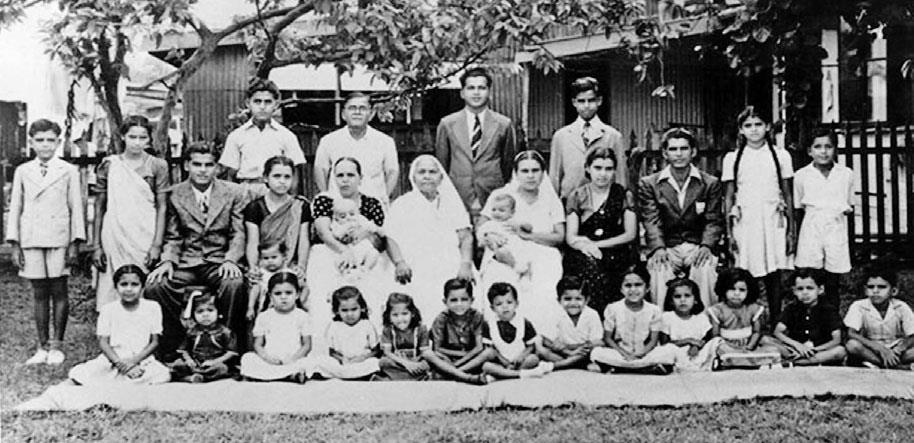


INTERTWINED with the rich history of Labasa Town, the Jaduram family’s existence can be traced back to the humble beginnings of the town as a sugarcane farming district in the colonial era.
Through the insight and industrious mind of Jagannath, who came to Fiji in the late 18th century as a girmitiya, he earned enough from the cane fields to acquire large portions of land from the Tui Labasa.
Labasa businessman and grandson of Jagannath, Paul Jaduram, said his grandfather was accompanied by his late grandmother, Bechauni, who hailed from Calcutta.
Both sailed to Fiji aboard the Leonidas.
Mr Jaduram said his late grandfather established his shop at the spot where the present day Hotel Takia stands.
“When I think back, this man sacrificed all to come to a strange land and work from the land to begin a business that would turn to what it is today — almost an empire,” he said.
“With money he saved from the cane fields, he began his business in an era when non-Europeans were thought less of in the business sector.
“The late Jagannath and Bechauni had a son, Seth Jaduram, who married Jagwanti Wati between 1923 and 1924 and had 13 children.
“My grandfather had a brother who also came as a girmitiya, a teenager like my father named Nanhu.”
Mr Jagannath then married Bechauni when she was 13 years old, and they settled on the other side of the Labasa River on which the town currently sits.
“My grandfather bought a property on the other side of the Labasa bridge around 1930s where the town is located now,” he said.
“Now this is the interesting part because back in that day the locals were not allowed to enter the MH Supermarket in Vulovi set up by the Europeans because it was only for the whites.”
Seeing this, Jagannath and his brother Nanhu, felt the need for a service that catered for other races (locals) apart from the whites.
Mr Jagannath and his brother Nanhu started a company in the 1930s and named it Jagannath, Nanhu and Company.
The first building they built was a general merchant store which sat directly beside the site of the North Winds Hotel belonging to Mr Paul.
A wide variety of merchandise were sold at the store. Then they built the Majestic Theatre before expanding their company and opening up other stores and businesses, some of which were in the form of shacks at the time.
“Nanhu’s house was where the Amrit Arcade now sits whereas my grandfather’s house was situated where RB Patel is now,” Mr Jaduram said.
“My grandfather had a jetty at the back.
“He used to get all his goods from Suva on his boat and anchor it at the jetty and then the goods were transferred to a cart pulled by bullocks and that was how they serviced the other part of the community.”
Mr Jaduram’s father, Seth, was brought to Fiji towards the end of the girmit system.
His mother, Jagwanti Wati, was Jagannath’s only child.
Since Mr Paul’s mother was the only child, her parents sold off most of their properties which had blossomed over the years to Indians who were coming in from India.
His father, Seth Jaduram though had begun working on Taveuni labouring at JV Tarte’s copra plantation.
When his parents married, Mr Jaduram’s father, who was already managing his own business, took over Jagannath, Nanhu and Company.
He renamed it Jagannath, Nanhu & Jaduram Ltd in 1968 before rebuilding the old shacks into what they are now.
“We used to supply electricity to the Post Office which was in Vaturekuka.
After that the buildings on the other side of town (Vaturekuka side) were moved to where the town is today,” said Mr Paul.
“The town then began taking shape with the inclusion of tailor shops, a theatre built by my grandfather named the Majestic Theatre, a photography shop and blacksmiths.
“Our property extended from the current Fiji Development Bank site to Amrit Arcade.”
European settlers According to Mr Jaduram, the first European settlers landed on Malau and moved up to where Vuo Village is now.
The settlers then pitched their tents there while they were developing the area and established their trade in cotton wool.
Vuo Village used to be a cotton field and the workers were from Mali Island because it was close to Vuo, and during that time, US used to import cotton from the cotton fields in Vuo.
“During the Civil War in America which was from 1861 to 1865, there was no demand for cotton. So the settlers thought of exploring further inland hoping to see something where they could do their trading,”
Mr Paul said.
The settlers then found flat land in Vunivau, opposite All Saints Secondary School and also in Vunika.
“The tramline that runs through Vunivau, where the flat land is, that’s where the coolie line was.
This I know for a fact. That was the coolie line. That’s when the girmitiya came.
“That’s where my grandmother was,” he said.
“The settlers chose Vaturekuka as their fort because it’s perched on a hill and it allowed them the opportunity to be on the lookout in case of invasion by the natives.
“From there they could also see if the girmitiya were working or not in the fields.
“Later on they built the post office, police station, magistrates court, all licensing authorities.
They were all up in Vaturekuka.
That was in the late 1930s.
“We used to go up there with our bicycles and pay for our bicycle licence, dog licence, and radio licence,” he said.
According to Mr Jaduram, when more whites started arriving, they built Morris Hedstrom in Vulovi, which is opposite All Saints Secondary School.
“They built it there because it was closer to where their trade was, in Vaturekuka, the fort,” he said.
“Around the 1940s, the market used to be where the Fiji Sugar Corporation (FSC) boiler is. They built it there because the expatriates were working at the mill and either lived at the FSC compound or in Vaturekuka.
“They had everything on the other side of the Labasa bridge (Vaturekuka side).
Currently only Paul and his brother Tula reside in Labasa Town managing their hotel and construction businesses while their 11 siblings stay Overseas where they have established themselves successfully.