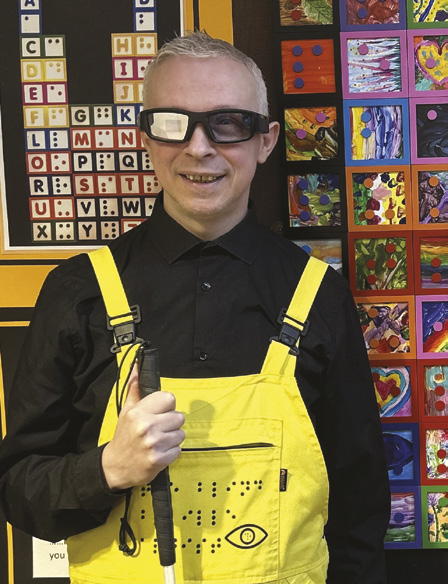


Diagnosed with deteriorating eyesight from a young age, Clarke’s passion for art has been a constant in defying the challenges that life has presented him.
Slowly losing his vision to rod-cone dystrophy, Clarke developed a distinctive creative language that turns Braille into large-scale, vibrant artworks that can be read by touch and seen by sight.
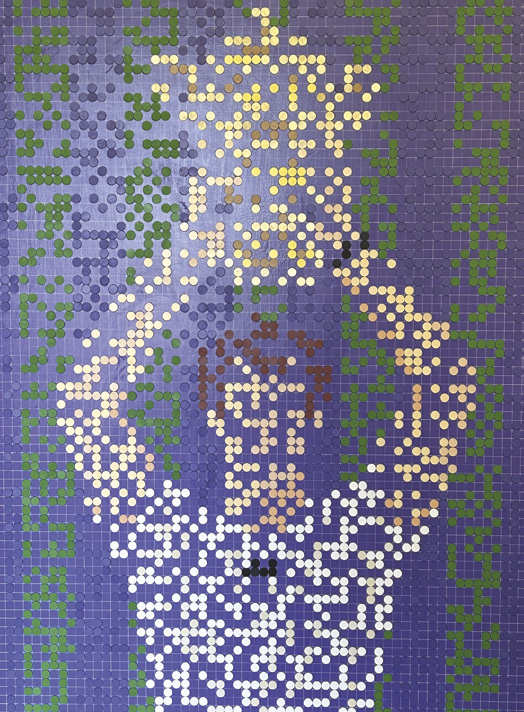
Blending colour, pattern, and texture, the Portsmouth based artist has redefined what it means to communicate through creativity, pioneering a unique artform with intricate works constructed entirely from braille dots.
“Braille is not merely areading system for me, it’s a gateway to literacy, independence, and self-expression,” said 45-year-old Clarke, who, with just five per cent vision, is registered as severely sight impaired.
“While many view braille as purely functional, I see its aesthetic potential, the rhythm of raised dots, the geometry of spacing, and the tactile language embedded within patterns.
“It’s how I turn dots into stories. It’s why my blindness is a superpower not a limitation.”
Clarke’s Superpower
Finding that superpower and utilising it to show people that blindness is not a deficit, but a different way of understanding and contributing to the world, has not been easy.
Growing up in Portsmouth on one of the city’s most deprived housing estates, he lived in a household where domestic violence and heavy drinking were the norm, and his stepfather frequently sold his toys to buy alcohol.
At six-years-old Clarke first received a diagnosis of vision loss. Being in the eighties it meant sitting at the back of the class at school because he was considered a ‘health hazard’. He had lost the sight in one eye and wore glasses.
Despite his struggles and the mickey taking, Clarke knew he wanted to be an artist, and his teachers encouraged his passion for art. His dream was further threatened ashe contracted Lyme Disease at 13 and left school at 14 due to issues with his kidneys.
“But I was a fighter, and after I got through that, and it took me a couple of years, I went back into higher education at 18 and did a GNVQ,” said Clarke.
“I earned a diploma in art design, applied to university and started a fine art course. It was then that I noticed a significant deterioration in my vision, so changed by degree course to model making.
“I graduated in 2006, just as the economy went to pot. And so basically, for 10-years, I stacked shelves until I finally got a job using my degree and became a dental model maker.
“Then eight months into the job I was referred to an ophthalmologist who confirmed further deterioration of my eyes and that I was going blind. I was 32 years old.
“I had to give up my job and at the same time face up to losing my home through a no-fault eviction and come to terms with my daughter being diagnosed with mild cerebral palsy.
“It was a case of ‘what do I do? How do I live my life? How do I support my family?’”
Braille Artwork
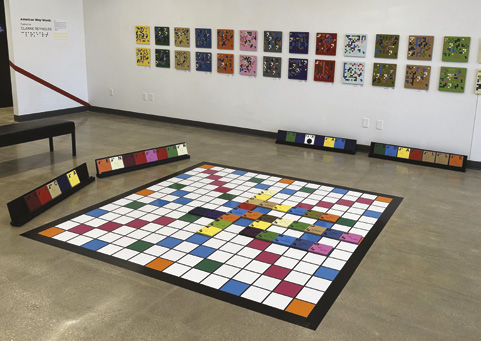
The answer to all three was discovering braille, which rekindled his artistic career. Clarke began using braille not just to write messages, but to construct images and conceptual pieces. He created large-scale artworks composed entirely of raised braille dots, textured surfaces arranged in precise formations.
To a sighted viewer, his works initially appear abstract. But for those who read braille, hidden messages, narratives, or conceptual statements are revealed through touch.
“Through my work I’m not only raising awareness about accessibility but challenging perceptions of what it means to ‘see’ art and for braille art to become recognised as a contemporary art form that belongs not only to the blind community but to everyone,” said Clarke.
Clarke’s work has been exhibited in galleries across the UK and internationally, captivating audiences with his bold use of colour and narrative, and his innovative approach to art has earned him significant recognition.
He is an Ambassador for Fight for Sight, Patron for the charity VICTA and, as his snazzily dressed alter ego Mr Dot, is in high demand to visitschools to share his experience and encourage others, both blind and sighted, to explore art as a tool for empowerment and expression.
A Fine Fellow
In September he will be one of 60 Venice Fellows chosen by the British Council to represent the UK at the British Pavilion at the 61st International Art Exhibition in Italy.
A unique opportunity for creative individuals, students, researchers, artists and professionals at the early stages of their career, to spend a one-month residency in Venice during the world’s most important art and architecture biennales to develop their own creative and research projects.
“The best thing about it, what art has given me, is it has given me a purpose, a reason to live,” added Clarke.
“Every day is a new day. It’s like being born again. I just don’t know how or what I’m going to see, every day is so different. So exciting and full of promise.”
To find out more visit https://mrdotuk.com/
“ There’s nothing different to me. I’m blind. I’m a blind artist and I’m proud to be blind.