

HBO’s short-lived, but intense, music-business drama Vinyl, which ran for a single season in 2016, evoked its 1973 time frame with such period features as rotary phones and polyester pants. It also paid painstaking attention to technical details, shooting some of its recording-studio scenes in 1970s-era production facilities, including Electric Lady Studios and Avatar Studios (neé Power Station). There, the production crew could access battleship-sized audio consoles and multitrack decks stacked taller than the engineers who tweaked them. Knowing that many viewers would be intimately familiar with those environments, Vinyl’s production designers went so far as to connect one of the shooting-stage dummy consoles to the output of the production’s audio-playback deck, so the ballistics of the VU meters on the console bridge would exactly match the dynamics of the songs of the show’s diegetic soundtrack.
Ryan Rumery, the sound designer for Stereophonic, now playing at Broadway’s Golden Theatre, didn’t go quite that far with the technical details for the play, which is loosely based on the lengthy and dramaladen production of the Fleetwood
Mac album Rumours, but he definitely thought about it. (The production, a smash hit at Off-Broadway’s Playwrights Horizons last fall, has earned a record-setting 13 Tony nominations.
It picked up eight nominations from the Drama Desk and was named Best Play by the New York Drama Critics’ Circle.) “You have to consider how much detail can the audience see in a theatre,” Rumery says. “But I was also always thinking, What’s the audience going to notice and take away from this? The vibe is to make it as though you’re actually sitting in the [studio] control room.” He’s aware that a New York City theatre audience will have its fair share of musicians, record producers, audio engineers, and other studio cognoscenti, all ready to hit social media and point out any anomalies in the technical details. But he says he was ready for that. “If you’re looking for period details, we have plenty of them, and they’re all accurate and authentic.”
The centerpiece console
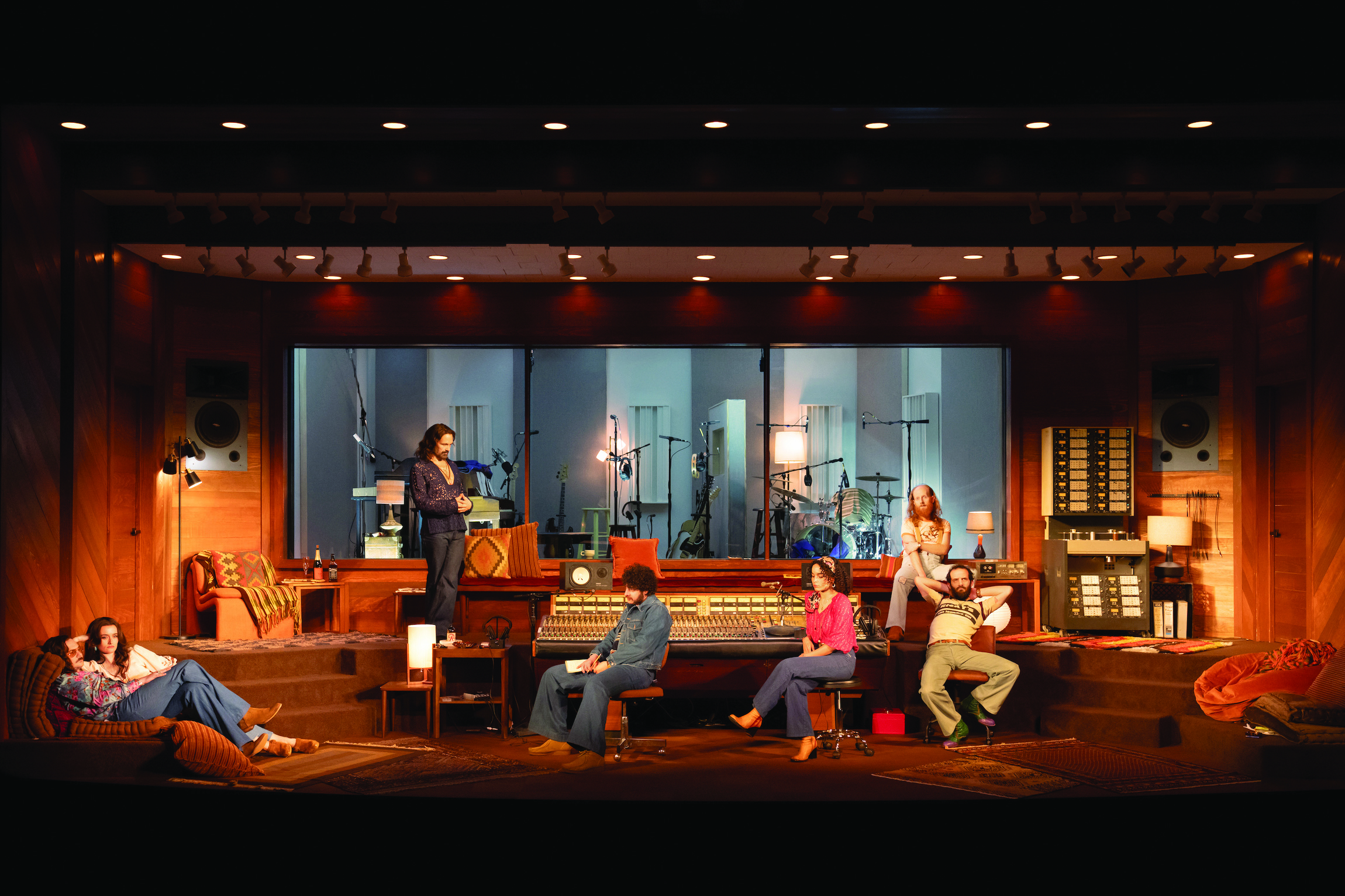
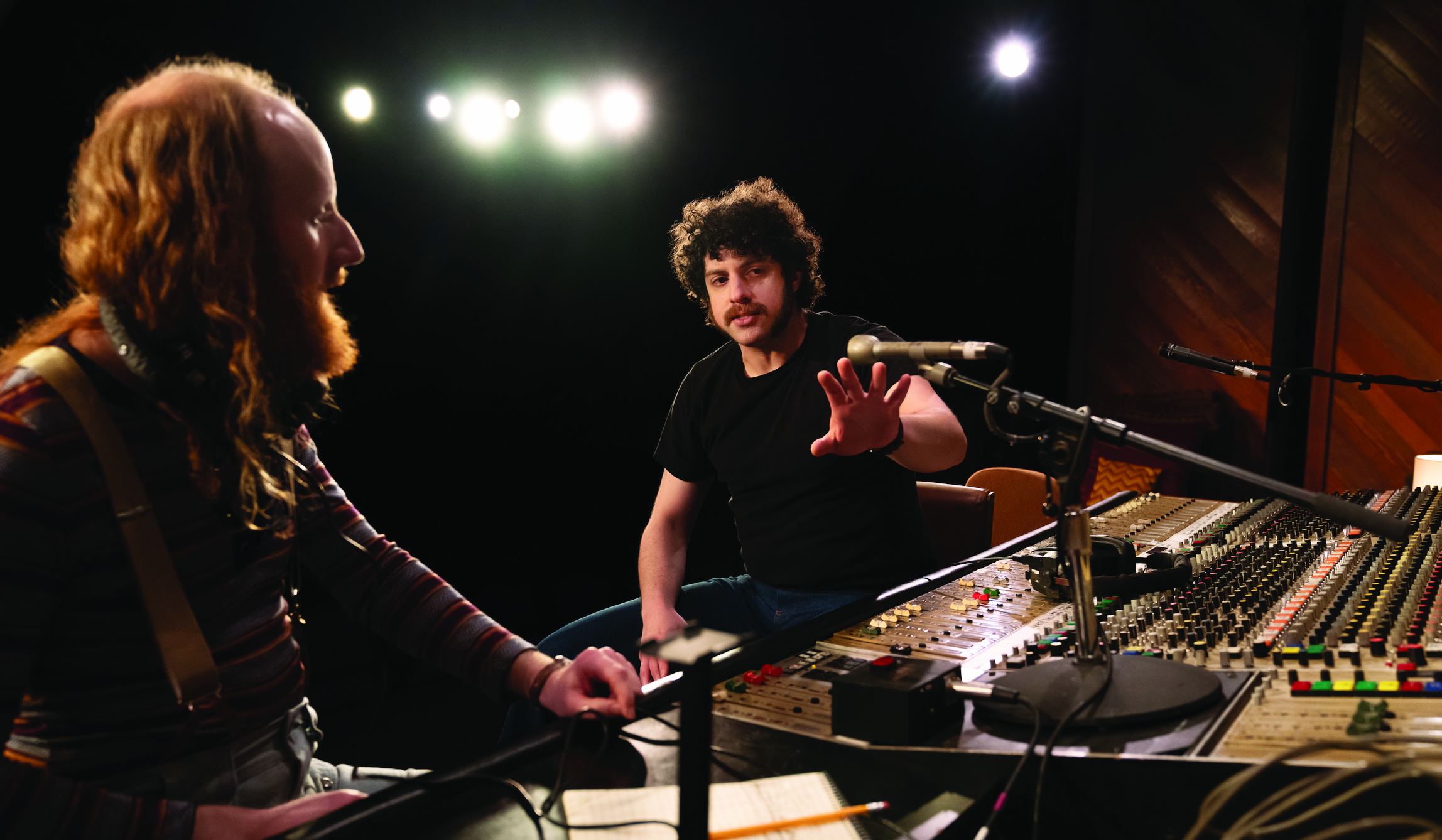
For starters, there’s the main console, which sits at center stage, serving as a visual anchor for the play’s characters and plot twists. It’s a 1970s-era Cadac G Series desk supplied, like most of the rest of the show’s audio complement, by Masque Sound.
“Everyone on the team was convinced we had to have a period Neve console, but I was like, ‘There’s no way we’ll ever get one of those’,” Rumery says. “They’re relics! The Cadac was the closest thing that would be from the era and also be working. The thing about vintage consoles like that is they often broke down, and we couldn’t have that happen on a live show.”
The console does indeed have to work: Part of the song “Bright,” which reprises several times before closing the show, is mixed live onstage during one performance, with the cast members moving faders through which are passing six tracks ofstems—drums, guitars, vocals, keyboards, etc.—from the prerecorded soundtrack after they also pass through the DiGiCo SD10-24T frontof-house console into the d&b audiotechnik PA system. Those stem tracks reside on QLab show-control software.
“The QLab cues are triggered via MIDI from an ETC Eos lighting console,” says John McKenna, the show’s associate designer. “This allows for a tight integration betweenlights and sound, which shows up in the transitions.” It not only adds a level of realism and immediacy to the production but also takes the pressure off Nora Simonson, the show’s mixer. “We were worried that Nora might not have enough hands to do all of that,” Rumery jokes. “But letting the actors actually mix a song live onstage is as authentic as anyone could ever get, although we would want to have some control at the front of house in case something would go awry.”
Front of house
This is the first Broadway show for Simonson, who uses they/them pronouns.
They shepherded the live mix starting at Playwrights Horizons, where they perfected the show’s complex microphone transitions. As actors move back and forth between the partitioned recording space and control room, their dialogue is picked up by a combination of wireless lavs (added for the Golden’s larger auditorium); thevocal microphones, which are left open as needed for dialogue; and four area microphones—two Neumann TLM 170 and two KM 184—placed strategically in the recording room to pick up dialogue. “I had to learn to follow the actors, to know where they would be at every point, so the right mics are open and they could hear their cues,” Simonson says. “The 170s are right in front of the studio window, and they look like what a typical studio would have set up as an extra communications mic, so people could talk and hear each other in each room.” A similar transition takes place between the d&b PA and the NS-10 studio monitors on the meter bridge, to introduce a new scene.
The need to make sure everyone can hear their cues is the show’s main challenge, Simonson notes: “There’s pressure to make sure I get all the pickups right, because if I don’t have the right microphones up, they won’t be heard, and that would derail the show. It’s an extra level of pressure for a show like this, but we worked out the language for that over a week and a half of sound checks.”
Making it vintage
While the console itself is largely a prop other than the six channels that pass audio, a lot of effort went into the audio processing to achieve that 1970s analog sound. Rumery integrated Universal Audio UAD plug-ins, using an Apollo 16X interface, to achieve the vintage sounds that would have come from the 24-track Studer 2" tape deck and tube-driven microphones (working versions of both are onstage, with the Studer deck connected to Reaper DAW software to play back several live music cues onstage). The signal path is from the microphones and direct insertions onstage to the DiGiCo console with a split to the Cadac desk, which also provides monitoring for the stage (including a pair of vintage Yamaha NS-10 speakers on the meter bridge, which can be heard by the audience) and Beyerdynamic DT-770 headphones used by the cast. For instance, the Universal Audio UAD virtualization of a Neve 1073 preamp, applied to the console master buss, generates much of the gritty vintage sound during the show. “Universal Audio is the only company that’s close to [reproducing] the actual hardware processors; they’re just so much more real,” the designer says.
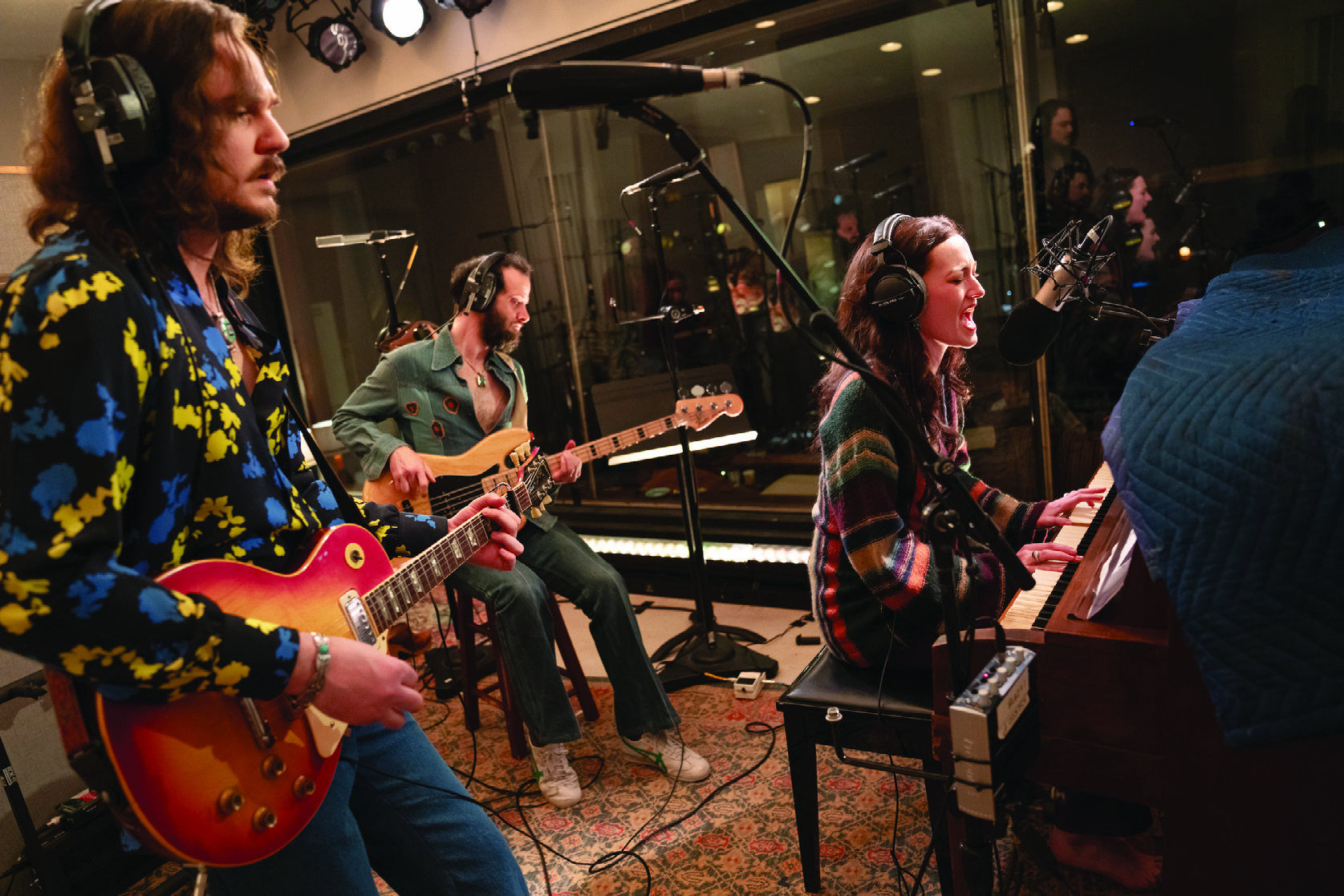
“We’re using the [Teletronix] LA-2A [compressor] plug-in, the Pultech[EQP-1A equalizer] plug-in, the [Universal Audio] 1176 [limiter] plugin—all of those classic pieces of gear.” More of that same vintage sound comes from the musical instruments, such as the 1968 Fender Precision bass provided by music retailer Sam Ash. “Some of the direct sounds, like the bass, we’re not processing at all, because those instruments were the sound then,” Rumery says.
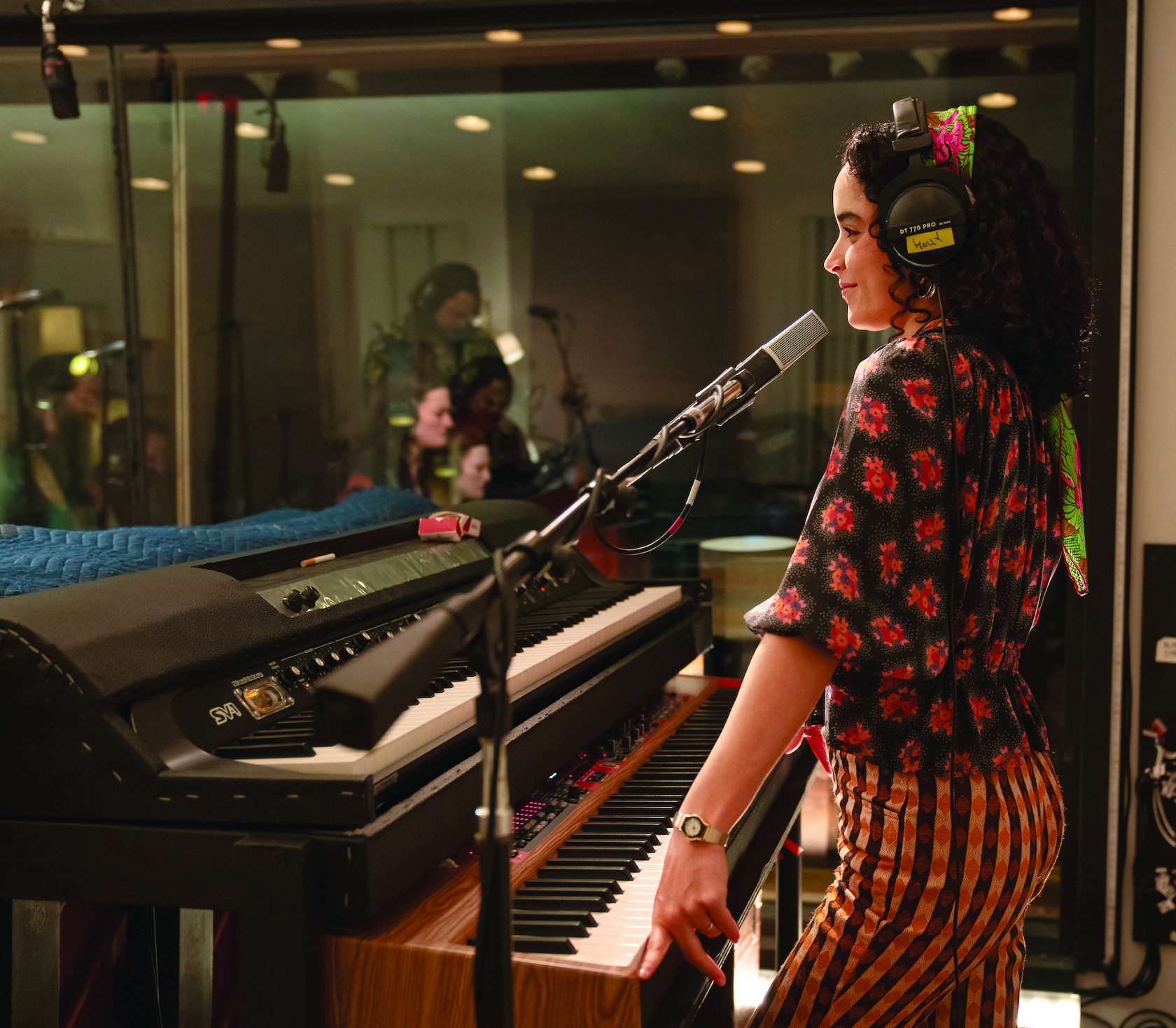
The microphones, as well as the singing and playing that pass through them, are all quite real. While the actors wear Shure Axient ADM Series wireless units for dialogue, the vocals use the velvety-sounding tube mics in the studio, which also pick up dialogue and banter between the control and recording rooms, as does the console’s appropriately tinny-sounding talkback mic.
“I’ve had people tell me you got all those cool-looking prop microphones and I’m like, no, no, no, those, that’s a real Sennheiser 441 that they’re singing into,” Rumery says. “Because that’s what a lot of theatre shows would do: just put all that through a wireless microphone and a prop microphone and it would be just gross-sounding. I say that over and over to people: It’s all real, it’s the actual microphones. They never sing through the wireless microphones.”
Sonic details
The console may be the technical centerpiece but there are plenty of other details to dig into, much of it sourced through Dylan Farrow at Playwrights Horizons and Lenny Grasso at Masque Sound, vintage audiophiles who became enterprising scroungers for Rumery in the show’s design phase. They helped source such components as the pair of Neumann U87 condenser vocal microphones found at Masque Sound’s Secaucus, New Jersey warehouse.
(The designer says they “sound like butter.”) The guitar sounds also rely on vintage equipment like the Vox AC15 guitar amplifier, miked with Shure SM57 and Royer 121 microphones as they might be in an actual studio setting. The amps used in the show are kept in a space below the stage, miked live, and fed to the stage and house sound systems, with their stomp-box pedal processors operated remotely from there as well by the show’s A2s.
“The musical performances are all real, but the Golden [Theatre] isn’t designed like a recording studio,” Rumery says. “We did a workshop where we had the bass amp, guitar amps, and keyboard amp all in the same area onstage, but it was just too much [sound] to manage. We’d never be able to do that in the live room and have the control and isolation we need for a show. Besides, a lot of the time you’ll iso[late] a guitar amp in a studio anyway, to have control over the volume, so we’re still staying true to how sessions are actually done.” He had Owens Corning absorptive insulation material added to the stage area to reduce reflected sound and offset the reflectiveness of the glass partition that separates the control room from the studio; he also added diffusion to some walls and placed rugs on the floor, all acoustical treatments that would also be at home in any recording studio.
House sound
The PA, provided by Masque Sound, is a d&b audiotechnik system comprising mainly Y-Series loudspeakers buttressed by E-Series boxes, arranged in both line-array and pointsource configurations, with six subs (two B4 and four Y subs) mounted under the stage. Its main challenge was the Golden’s grid capacity: the Spanish-styled, 800-seat venue (which coincidentally was named Theatre Masque when it first opened in 1927) hasn’t hosted any of Broadway’s more technologically ambitious productions. Rumery says an initial PA design had to be quickly revised when weights were calculated.
“At the last second, we had to change our line array configuration because it weighed too much,” hesays. “We were going to hang most of the subs on the truss, but then found that it couldn’t hold them; we had to take the set apart and negotiate to cut areas for them and put them underneath the deck. The Golden has never had a big sound system in it before until this show, so we had to split the array up and completely change the center cluster. It was very run-and-gun there for a little bit, but we got it right.”
Rumery, a longtime user of Meyer PA systems, says the d&b sound fits better with this show’s analog sonic ethos. “When you listen to d&b boxes right out of the gate, no EQ on them, it’s a darker, more low-end sound, whereas a Meyer system tends to be very bright, and you’re always trying to take some of the brightness out of the system and trying to add bass. I approached the PA like I was mastering a record—it’s easier to roll off bass than to add it.”
Keeping it real
Rumery says all the effort put into authenticity has paid off. “It feels like you’re sitting in the control room, listening to the conversations that the actors are having in between songs,” he says proudly. “Even the reverb is still on their voices as they talk to the control room from the other side of the glass! I mean, it’s as authentic as it could be.”
This was confirmed after the cast performed a song on The Tonight Show Starring Jimmy Fallon on May 6.
Josiah Gluck, a music mixer on Saturday Night Live, which is produced in the same building, stopped by the edit suite after the show and complimented its authenticity, including its studio-quality drum sounds. Of course, everyone has notes. “He did notice that the red recording lights on the Studer weren’t lit,” Rumery laughs.
Another expert noted that the NS-10 monitor speakers didn’t come out until 18 months after the play’s putative time setting, but Rumery had a quick comeback: “I told him we had a prototype pair.”