

The newest addition to Washington, DC’s formidable lineup of museums is the American Dream Experience, part of the Milken Center for Advancing the American Dream. Housed in the former home of the Riggs Bank (known as “the bank of the Presidents”), it is the latest project of Michael Milken, the era-defining financier, who, following his indictment and imprisonment, reinvented himself as a philanthropist.
(His sentence later received a Presidential pardon.) Unsurprisingly, the center is devoted to the wonders of capitalism. Less obviously, it is concerned with social justice. Its mission statement notes that it “was established as a beacon to the world to honor and preserve the ideal that everyone, everywhere, regardless of their age, race, gender, religion, or background, should have equal opportunity to pursue a life of meaning and fulfillment.
That simple yet profound belief has endured wars, financial shocks, pandemics, natural disasters, and other woes that have befallen us throughout history. Yet, even as the Dream has been realized by many, and despite the barriers they may have encountered,equal access to the Dream does not exist for everyone.”
Designed by Rockwell Group, the American Dream Experience is packed with interactive features. The Tree of Generations features nearly 1,000 OLED images of visitors to the center. Visitors can have conversations with “hologram ambassadors,” learning from Sara Blakely, founder of Spanx; tennis legend Serena Williams; CNN medical commentator Dr. Sanjay Gupta; and Sal Khan, founder of the online Khan Academy.
Visitors can also step into a 360° holodeck and explore three stories of American dreams.
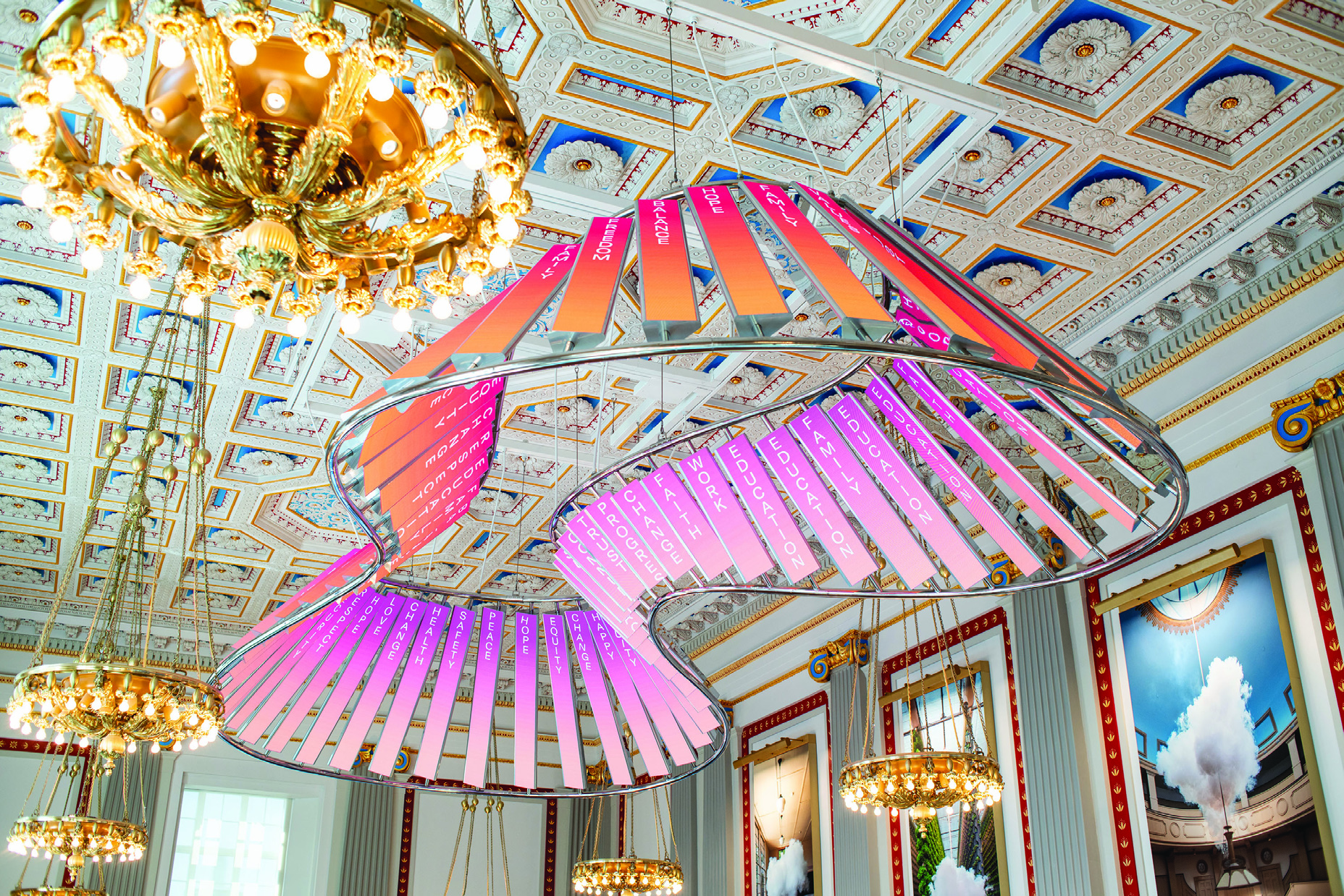
Particularly eye-catching is theWord Cloud, a kind of helix shape, hung from the 45'-high, recently renovated historic ceiling, consisting of LED blades that feature a constantly changing parade of terms related to the museum’s message. At any time, they may include “growth,” “equality,”“immigration,” and “justice.”
The Word Cloud was the work of the LAB at Rockwell Group, New Jersey-based IWEISS (who manufactured, constructed, and installed it), and Lorton, Virginia-based Design and Production (a specialist in building museum experiences). Hung in the space known as the Hall of Dreams, it is “an invitation to contribute your voice and explore your own definition of the American Dream,” says David Tracy, director of creative technology and senior associate, LAB, the Rockwell Group studio focused on creating engaging and evocative experiences by merging story, architecture, and technology. Noting that the firm’s work reflects founder David Rockwell’s sense of theatre, Tracy says, “This is meant to be a space where guests can reflect on the voices around them and consider their own definitions of the American Dream. They’re presented with a list of words they can contribute to the Word Cloud; they can also input their own words with an 18-character limit. The space transforms every six minutes, becoming a cloudscape or night sky that unifies the [mezzaninelevel] guardrails and canopy.” The guardrails are covered in a transparent LED film that takes imagery.
The design, a collaboration between Rockwell Group’s LAB and architecture and graphic design studios, underwent revisions and was then sent to Design and Production and IWEISS for construction. Among other concerns, Tracy notes, “The pick points in the ceiling are designed for certain loads, so the canopy had to be optimized to meet weight limitations.
It weighs under 8,000lb, which is well within the conservative limitations of the pick points. But there was a lot of coordination with IWEISS about landing on a solution that checked all the boxes.”
IWEISS faced multiple challenges, beginning with designing and engineering custom support structures to accommodate the LED panels, ensuring the installation’s long-term stability and reliability, and coordinating with the other contributors. Just as Rockwell’s team brings a theatrical sensibility to its designs, IWEISS leverages its decades of theatre expertise, applying it to custom projects such as this. Here, the company’s tasks included precision metal fabrication, theatrical rigging, and automation.
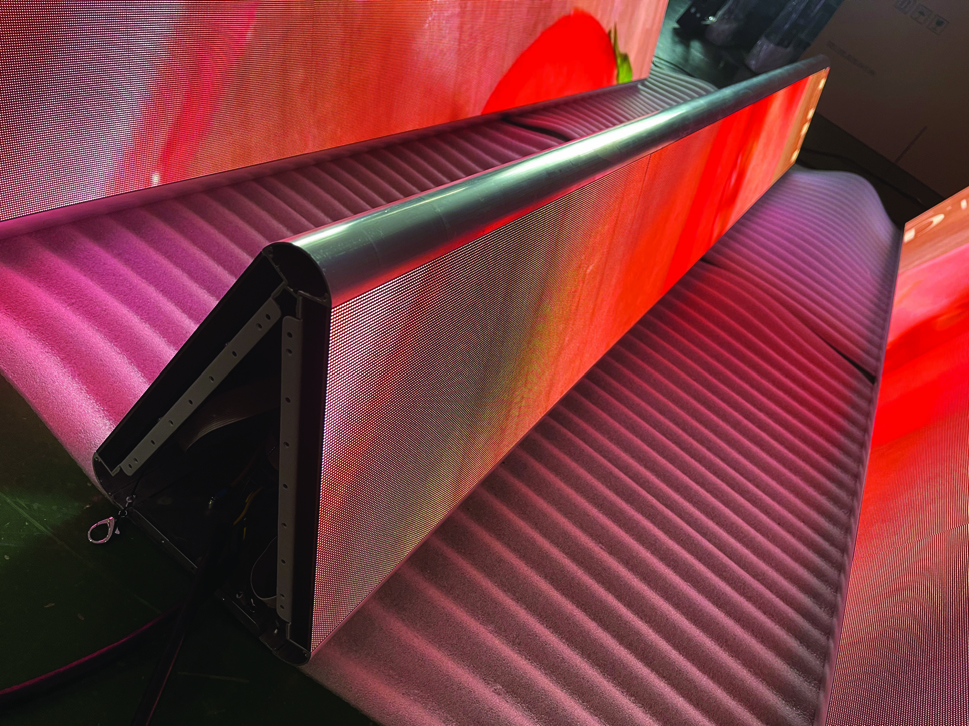
One big to-do item was finding the right LED product. PixelFLEX, the Mt.Juliet, Tennessee-based manufacturer, was invited to participate. The company supplied an array of triangular LED cabinets with custom 1.9mm pixelpitch tiles. Each fin of the structure consists of three surfaces: two active LED display panels and one mirrorbacked face. The structure is based on a dual perspective: Content on the inner sides is optimized for groundfloor viewers; the outer faces are aimed at attendees standing on the room’s second level. The rotational alignment of each fin was uniquely calibrated using precision tools, allowing content designers to map visual elements based on sightlines.
Richard Parks, vice president, IWEISS, notes that service was a key factor in choosing PixelFLEX: “The diodes [in all LED products] are made by the billions in a particular region of the world, no matter who you buy them from. It really comes down to who you are collaborating with. Who is going to engineer the product? Who is going to service it? Who is going to be a team member? It was clear, after meeting with PixelFLEX, that they were the company we could collaborate with on this aspect of the project. And they delivered on what we required.”
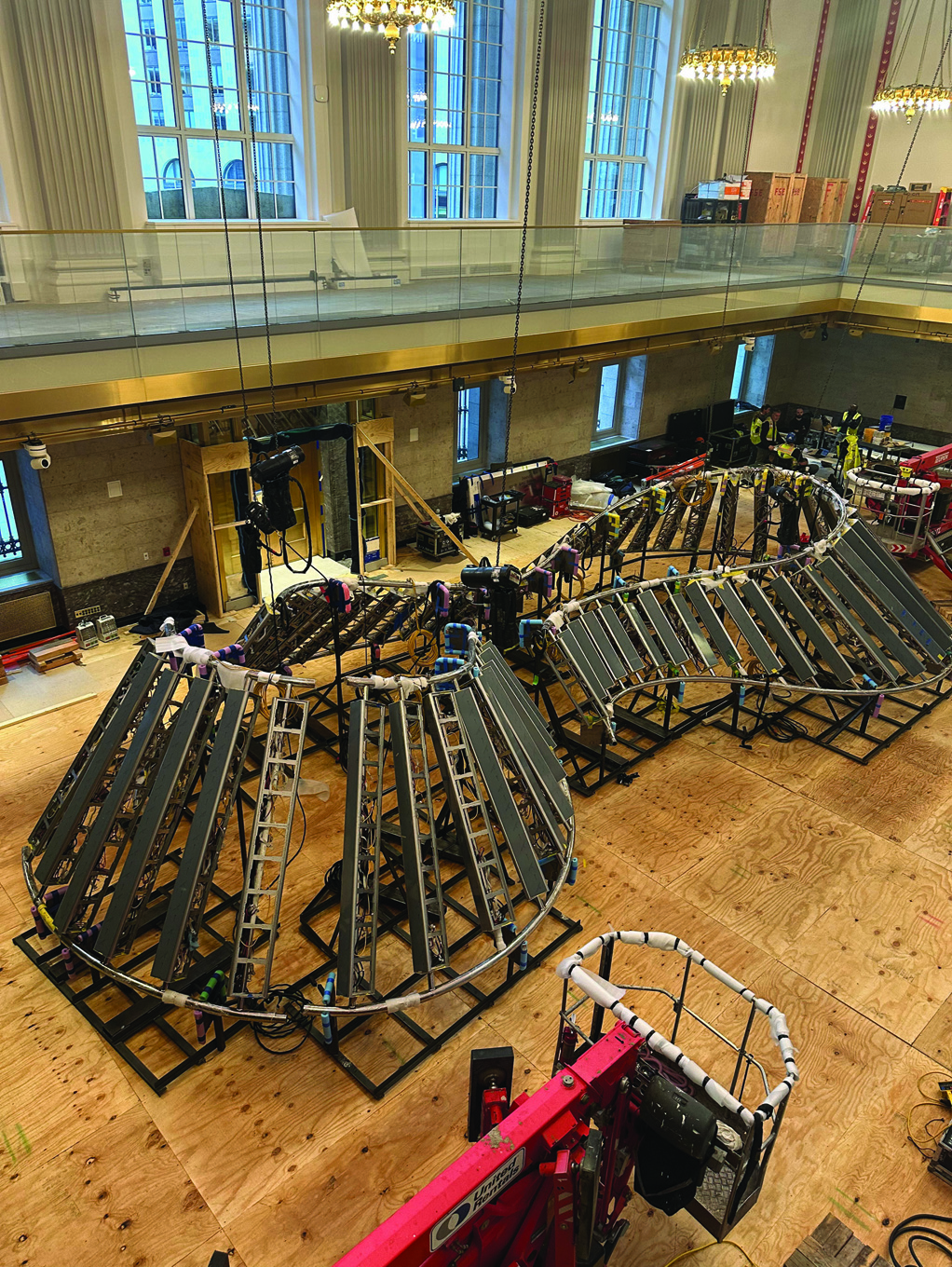
Once the PixelFLEX product was chosen, IWEISS staff participated in the creation of mock-ups, the engineering and design of custom support structures, fabrication and installation, plus integration of LED technology.
The final product was rigorously tested.
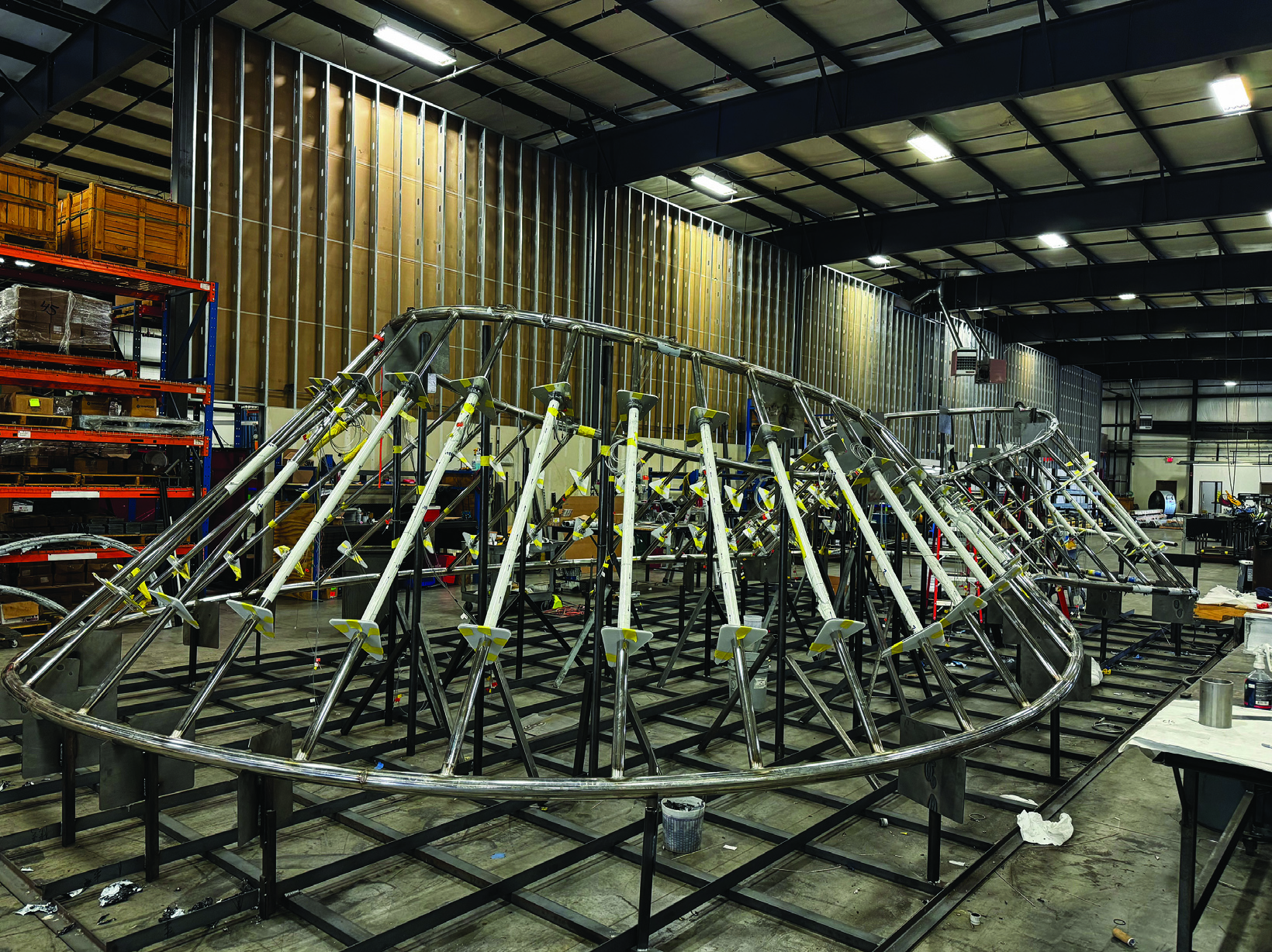
Emphasis was placed on getting the most elegant possible result, notes Parks. Everyone involved “wanted it to be a floating structure. They didn’t want to see any electrical wires. We had to design the core pieces of the structure so it could function as a conduit, handling all the data, communications, and power conductors seamlessly.
We also went back and forth, coming up with a determined size, working with engineering to ensure the gauge thickness was structurally sound for the piece’s overall weight.
Then we had to break the pieces into spliceable sections engineered for shipment and on-site reassembly.”
Parks adds that the unusual shape exists “in tension, or in compression.
There are many different vectors within the structure at any point in time. It was a challenge to manipulate each section in terms of how it should hang and fall, then bolting on another section, and manipulating how it wanted to hang and fall. We collaborated with Clark Reder Engineering on developing the structure and the support system, and it was a home run.”
The frame, Parks notes, “is made of stainless steel, hung with a 3" top cord and 3" bottom cord. The vertical pieces are all 1.5". The mirrored steel had to be polished to the core.” Other steps in the process included “welding the pieces, applying the LEDs, wiring the LEDs, all inside that stainless-steel structure.” It was hung in pieces, and, in its unfinished state, Parks notes, “Hanging out of one end would be 200' of cable that we had to fish through the next piece of the unit and up through the ceiling, where the ultimate power feeds were.
“We did a ton of prep,” Parks adds.
“We double-checked and factory-tested everything. We basically installed it in our fabrication shop in Springfield, Missouri, before sending it into the field. We also had a fantastic crew.
We’ve been utilizing [DC-based] IATSE Local 22 for several years on the National Air and Space Museum, and they’re top-notch. They’re real Renaissance craftsmen: They’re not just electricians or carpenters; theyhave all the skill sets.
“This project underscores our strategic shift towards providing comprehensive, turnkey solutions beyond our traditional offerings,” Parks adds, “We moved beyond simply supplying components to becoming a key partner in bringing complex designs to life.
Our ability to collaborate closely with designers, production teams, and technology providers allows us to tackle projects that demand a multidisciplinary approach.”