Delivering Value one parcel at a time
A conversation with Chris Ashworth


Chris’ work at Hermes as CIO follows the familiar, tried and tested pattern of first establishing credibility with your business colleagues through fixing things and providing the stable platform for the business. Then building on that platform to kick off the delivery of a digital transformation programme. What’s different with Chris, his team and Hermes is that they have followed that pattern and delivered on it fast.
In just two years, the CIO is established as a key member of the senior executive team, actively involved in strategic business development with Hermes’ retail clients, alongside continuing to drive the digital transformation. Hermes works with 80% of the UK’s top 100 retailers, and delivers more than 330 million parcels every year. The transformation is enabling the delivery of both volume and revenue growth that is outstripping the market. In what is acknowledged as a highly competitive, slim margin business.
Chris is making his mark on the Greater Northern Technical Powerhouse too. He is in final stages of setting up a digital innovation hub for the organisation in Leeds city centre. So, how did he do that? What has it meant for Hermes and its customers? What has it meant for his team and himself?
In reflecting on our wide-ranging discussion with Chris, the three foundations seem to be:
an enduring, career-long capability that is grounded in the commercial aspects of digital technology;
deepened through a series of experiences as a senior leader that has developed a strong understanding of B2C businesses in general and logistics businesses and their associated models for value and cost drivers, in particular;
combined with a broad foundation across CIO domain built across many of the key areas of capability in how and where digital technologies can make a difference for an enterprise and its customers.
Chris has worked in sectors other than logistics. He started working in travel with a series of roles in Airtours, My Travel and Thomas Cook before becoming CIO in the gaming sector with Genting Casinos. But it is logistics where he thrives and in particular delivery businesses for the end customer, the so-called “last-mile” businesses. Chris has worked for Home Delivery Network, Yodel and now Hermes.
When in his first top role as IT Director at Thomas Cook, Chris amalgamated two major IT departments following the merger of MyTravel and Thomas Cook. He was responsible for the delivery of cost synergies that delivered £12m in year 1. He led the management and renegotiation of strategic outsourcer relationships and the rationalisation of the IT supplier base, delivering key projects including the relocation of IT data centres, the centralisation of UK voice and data networks; system consolidation projects; and outsourcing of specific functions of the department. Building on this travel sector foundation, before joining Hermes, Chris moved through senior IT leadership roles with Home Delivery Network, Yodel and Genting Casinos.
Hermes has established six national parcel services in the most important European e-commerce markets. The UK is the second-largest parcel market and continues to grow. Chris and his team have been a key part of the development of innovative and digital services. For example, Hermes became the first UK parcel company to fully integrate its end-to-end tracking solution with Amazon Alexa and Google Home smart speakers.
Hermes opened the UK’s largest automated parcel distribution super-hub at Rugby, the second largest logistics hub in Europe. Offering deliveries 7 days a week and with a ParcelShop network now totalling more than 4,500 collection points, Hermes’ UK parcel operations will continue to roll out its Digital Futures strategy, which we discuss later in the article, placing the customer experience at the heart of operations with updates including a new app, website, safe place photo and geo-fencing capabilities.
The first phase of Chris’ work was the Hermes Technology Transformation Programme, the programme was born out of what Chris described as a “challenging first year” culminating in a “peak” with some key systems having to be turned off. “Peak” is a common parlance in the parcels business, it’s that time when volumes typically double in the last quarter of the year, specifically from Black Friday through to January. This volume doubling happens just at the time when you lose daylight working hours, the weather is poorer and if you are not careful you can’t get lorries and staff in or out of the logistics hubs.
In the spirit of not wasting a crisis, Chris took the opportunity to quickly make the case for the Technology Transformation Programme. The programme re-platformed the UK business onto a cutting edge, scalable, real-time infrastructure. The technology investment was designed to improve services by migrating IT systems to strategic hosting platforms. The programme also provided the opportunity to rationalise the technology and reduce the footprint in the data centre.
Importantly for the IT team, the programme provided an over-arching IT strategy to focus their work in supporting the growth of the UK operation and to satisfy increased retailer and customer demand for richer products, delivery information in real time and a wider range of delivery solutions.
Key components used were Amazon Web Services (AWS) providing cloud based scalable and consumption based hosting and infrastructure, CloudReach providing the MSP for infrastructure management, ServiceNow enabling the new self-service desk, service catalogue, incident management and problem management and Apps Dynamics providing the monitoring and management of all IT services at a business, system, application and component level.
The engineering teams worked hard for 10 months and implemented the changes which in turn provided assurance that Hermes achieved retail client KPIs, support business critical processes and improve customer satisfaction during peak.
“By September 2017 we successfully re-platformed and tuned those under-performing elements of the IT infrastructure and migrated from the traditionally architected data centre to a new data centre in the cloud. The IT improvements proved to be a success and have been evidenced by our largest ever peak in 2017 with 40m parcels moving through the network in December alone, including 9.7m parcels during the busiest week. As a result of all the hard work Hermes has one of the largest peak capacity uplift capabilities in the industry.” Chris tells us.
Importantly some examples of the measures of business value included: client Invoicing process improved to reduce cycle time from 3 hours to 15 minutes, manifest feed process was re-written to save up to 30 mins per manifest, 35% of redundant functionality removed, old MI reporting was retired, saving 2 hours of processing time per day, 50% of file processing removed (300k jobs) and 50% of batch processes removed (7,500 processes).
The next step has been to build on the platform provided by the Technology Transfromation Programme to develop and implement a Digital Futures Strategy. Digital has become increasingly important to Hermes because customers have made a clear choice: they prefer to find information on their own as much as possible through self-guided, mostly digital means.
End consumers don’t want to spend a lot of time talking to people to track their parcel or to send a parcel. They are looking for clear, consistent interactions across channels and mobile devices via simple, easy to use means. Recent customer research highlighted a shift in behavioural changes and the relationship between Hermes and their Sender and Recipient customers. The research identified a number of improvements to address the digital and non-digital touch points for parcel delivery and collections.
This Digital Futures Strategy is a £55m project that prioritises the customer experience through investment in innovation and technology work. The work started with the design of a single web experience that not only covers the digital and human touch points for customers, clients, couriers and colleagues, but also supports sales by generating and nurturing leads and accelerating opportunities for the Hermes brands including Hermes, Hermes Send (the c2C element), ParcelShops, Business Accounts and International Shipping.
The aim of the website is to get Hermes on the path to building and optimising the Hermes cross-channel digital experiences. The solution is designed to centralise the technology under a single web experience management system, allowing Hermes to create a branded digital experience that spans across existing platforms without duplicating workflows and rewriting all the back-end services.
Hermes wants to improve how it interacts on all platforms with recipients. The technology includes, and is not limited to, offering tailored preferences to fit individual needs, including: payments and rewards, notification, preferred couriers based on recommendations, safe place options for leaving a parcel, authorised signatories and a reward account choice.
Developed using agile methods, there will be options to change and update deliveries, including cross channel interactions, should recipients wish to speak to an advisor or the courier, and proactive updates with personalised courier information including a photo and name.
The digital programme is underway, and a number of planned product launches are set to go live shortly. The roadmap includes investment in a new website, mobile app and an omni-channel digital product across web and mobile, which will give customers engaging personalised touch points.
An example of the digital programme starting to deliver customer value is the roll out its SafePlace Photo product and geo-fencing capabilities to end consumers, following positive feedback from retailers after it launched at the beginning of this year. Chris tells me: “SafePlace Photo, combined with the location tracking that Hermes’ hand held terminals also provide, will provide retailers and their end consumers with photographic evidence and co-ordinates of parcels left in a safe location and keep them informed. This combination of products helps retailers to lower costs, reduce contacts and improve customer satisfaction.
Geo-fencing provides a location and a map of where each parcel has been delivered, within a radius as small as 10m and updates can be pushed through a choice of channels, including SMS, email, app or website updates. SafePlace Photo enhances the overall delivery experience by providing consumers with added confidence that their purchases have arrived even when they are not at home.
This latest development will also benefit retailers by significantly reducing missed deliveries, incoming customer service enquiries and fraudulent claims. Hermes couriers will use their existing handheld terminals to take high-resolution images of parcels left in a predetermined or suitably safe location, and also record location co-ordinates. Retailers deploying SafePlace Photo will then receive the images as soon as they are taken; with the additional option to have the photos automatically uploaded into their CRM systems. Retailers will also benefit from an increase in first time delivery and a drop in incoming contact centre enquiries, as well as provide added confidence to reduce and reject fraudulent claims.”
Chris’s boss Martijn de Lange, CEO of Hermes UK, recently said: “SafePlace Photo combined with geo-fencing is the latest of our Digital Futures updates that reflects our vision to become the carrier of choice for every end consumer in the UK. It’s so important to take every opportunity to increase transparency throughout the parcel journey to continue to enhance the customer experience, and SafePlace Photo plus geo-fencing will help us and our clients to achieve this.”
The work of Chris and his colleagues was recently recognised by a visit of Matt Hancock MP, then minister for digital, culture and sport to the Hermes Newmarket depot in February 2018. Chris tells me that during his visit, Mr. Hancock trialled one of the ‘Pay and Print In Store’ devices, and met a Starship self-driving delivery robot. Hermes also showcased their Innovation Lab’s latest work, which includes options to use technologies including HoloLens and facial recognition software in the future. Mr. Hancock said that he was “thoroughly impressed” by the “commitment to innovation as a part of improving the delivery experience for online shoppers across the UK.”
Looking ahead, Chris is setting up a new team in city-centre Leeds to be the focus of Digital Innovation. The team is specifically tasked with developing a range of forward-thinking products that will change the delivery landscape. Chris sees digital innovation as an important part of his remit. He is committed to exploring new and exciting technologies that will allow Hermes to enrich the delivery experience. Digital assistants such as Siri, Cortana and Alexa have been developed to drive increased convenience, and research tells them that there will be a future shift away from screen interactions in favour of conversational interface technology.
Commenting on the future programme Chris said “we must also take advantage of new and exciting innovations in order to satisfy the demands of the increasingly tech-savvy consumer. In many ways the development of new technology acts as a catalyst for change, dictates our priorities and alters how we label ourselves – are we still regarded as a parcel delivery firm or a technology solutions business? I think the latter.” Additionally Chris shared his thoughts on a handful of specific technologies:
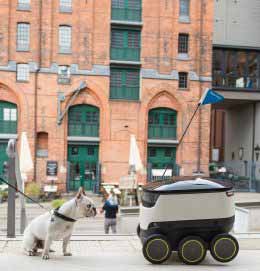
Autonomous vehicles and drones: “We have been part of an innovative testing programme for the use of self-driving delivery robots in London, in partnership with Starship Technologies. It follows on from a project which has seen Hermes Germany and Starship Technologies test parcel delivery by robot in three suburbs of Hamburg. We have used the testing period in the UK to better understand how the robots could enhance our ability to offer an increased range of on-demand solutions in the future, as part of our ongoing commitment to providing value-added services. We do believe that the self-driving delivery robots offer a viable alternative to drones, which are obviously difficult to deploy in built-up areas due to strict aviation laws, as well as their ability to only carry small and light packages.“
AI: “This is definitely an important part of our roadmap but it is about using it in the right places rather than just getting excited about the technology. As an industry we are extremely good at delivering parcels despite the low margins, but where things get complicated is when things go wrong. I see good customer service as a strong USP for us and automation can help with the simple stuff. For example, we are trialing a ‘self-service’ approach whereby the first six questions of any query can be automated. This can save us three minutes per query and it is also extremely convenient for the customer.
In addition, we were the first parcel company in the UK to fully integrate our end-to-end tracking solution with Amazon’s line of Echo smart speakers. Consumers can use voice commands via Alexa-enabled devices, to hear updates on where their parcel is. This unique functionality is part of our ongoing commitment to providing retailers with an increasingly innovative portfolio of services and solutions, as well as further enhancing the overall delivery experience provided to the UK’s growing number of online shoppers.”
In closing we asked Chris to sum up with the two things that he’d learnt through his work as a CIO, he told us that you need to:
- take time to look after yourself and the team;
- take time to get the right people on board, people that align with the values that you need of energy, determination and a bias towards empowerment.
In just two years, the CIO is established as a key member of the senior executive team, actively involved in strategic business development with Hermes’ retail clients, alongside continuing to drive the digital transformation. Hermes works with 80% of the UK’s top 100 retailers, and delivers more than 330 million parcels every year. The transformation is enabling the delivery of both volume and revenue growth that is outstripping the market. In what is acknowledged as a highly competitive, slim margin business.
Chris is making his mark on the Greater Northern Technical Powerhouse too. He is in final stages of setting up a digital innovation hub for the organisation in Leeds city centre. So, how did he do that? What has it meant for Hermes and its customers? What has it meant for his team and himself?
In reflecting on our wide-ranging discussion with Chris, the three foundations seem to be:
an enduring, career-long capability that is grounded in the commercial aspects of digital technology;
deepened through a series of experiences as a senior leader that has developed a strong understanding of B2C businesses in general and logistics businesses and their associated models for value and cost drivers, in particular;
combined with a broad foundation across CIO domain built across many of the key areas of capability in how and where digital technologies can make a difference for an enterprise and its customers.
Chris has worked in sectors other than logistics. He started working in travel with a series of roles in Airtours, My Travel and Thomas Cook before becoming CIO in the gaming sector with Genting Casinos. But it is logistics where he thrives and in particular delivery businesses for the end customer, the so-called “last-mile” businesses. Chris has worked for Home Delivery Network, Yodel and now Hermes.
When in his first top role as IT Director at Thomas Cook, Chris amalgamated two major IT departments following the merger of MyTravel and Thomas Cook. He was responsible for the delivery of cost synergies that delivered £12m in year 1. He led the management and renegotiation of strategic outsourcer relationships and the rationalisation of the IT supplier base, delivering key projects including the relocation of IT data centres, the centralisation of UK voice and data networks; system consolidation projects; and outsourcing of specific functions of the department. Building on this travel sector foundation, before joining Hermes, Chris moved through senior IT leadership roles with Home Delivery Network, Yodel and Genting Casinos.
Hermes has established six national parcel services in the most important European e-commerce markets. The UK is the second-largest parcel market and continues to grow. Chris and his team have been a key part of the development of innovative and digital services. For example, Hermes became the first UK parcel company to fully integrate its end-to-end tracking solution with Amazon Alexa and Google Home smart speakers.
Hermes opened the UK’s largest automated parcel distribution super-hub at Rugby, the second largest logistics hub in Europe. Offering deliveries 7 days a week and with a ParcelShop network now totalling more than 4,500 collection points, Hermes’ UK parcel operations will continue to roll out its Digital Futures strategy, which we discuss later in the article, placing the customer experience at the heart of operations with updates including a new app, website, safe place photo and geo-fencing capabilities.
The first phase of Chris’ work was the Hermes Technology Transformation Programme, the programme was born out of what Chris described as a “challenging first year” culminating in a “peak” with some key systems having to be turned off. “Peak” is a common parlance in the parcels business, it’s that time when volumes typically double in the last quarter of the year, specifically from Black Friday through to January. This volume doubling happens just at the time when you lose daylight working hours, the weather is poorer and if you are not careful you can’t get lorries and staff in or out of the logistics hubs.
In the spirit of not wasting a crisis, Chris took the opportunity to quickly make the case for the Technology Transformation Programme. The programme re-platformed the UK business onto a cutting edge, scalable, real-time infrastructure. The technology investment was designed to improve services by migrating IT systems to strategic hosting platforms. The programme also provided the opportunity to rationalise the technology and reduce the footprint in the data centre.
Importantly for the IT team, the programme provided an over-arching IT strategy to focus their work in supporting the growth of the UK operation and to satisfy increased retailer and customer demand for richer products, delivery information in real time and a wider range of delivery solutions.
Key components used were Amazon Web Services (AWS) providing cloud based scalable and consumption based hosting and infrastructure, CloudReach providing the MSP for infrastructure management, ServiceNow enabling the new self-service desk, service catalogue, incident management and problem management and Apps Dynamics providing the monitoring and management of all IT services at a business, system, application and component level.
The engineering teams worked hard for 10 months and implemented the changes which in turn provided assurance that Hermes achieved retail client KPIs, support business critical processes and improve customer satisfaction during peak.
“By September 2017 we successfully re-platformed and tuned those under-performing elements of the IT infrastructure and migrated from the traditionally architected data centre to a new data centre in the cloud. The IT improvements proved to be a success and have been evidenced by our largest ever peak in 2017 with 40m parcels moving through the network in December alone, including 9.7m parcels during the busiest week. As a result of all the hard work Hermes has one of the largest peak capacity uplift capabilities in the industry.” Chris tells us.
Importantly some examples of the measures of business value included: client Invoicing process improved to reduce cycle time from 3 hours to 15 minutes, manifest feed process was re-written to save up to 30 mins per manifest, 35% of redundant functionality removed, old MI reporting was retired, saving 2 hours of processing time per day, 50% of file processing removed (300k jobs) and 50% of batch processes removed (7,500 processes).
The next step has been to build on the platform provided by the Technology Transfromation Programme to develop and implement a Digital Futures Strategy. Digital has become increasingly important to Hermes because customers have made a clear choice: they prefer to find information on their own as much as possible through self-guided, mostly digital means.
End consumers don’t want to spend a lot of time talking to people to track their parcel or to send a parcel. They are looking for clear, consistent interactions across channels and mobile devices via simple, easy to use means. Recent customer research highlighted a shift in behavioural changes and the relationship between Hermes and their Sender and Recipient customers. The research identified a number of improvements to address the digital and non-digital touch points for parcel delivery and collections.
This Digital Futures Strategy is a £55m project that prioritises the customer experience through investment in innovation and technology work. The work started with the design of a single web experience that not only covers the digital and human touch points for customers, clients, couriers and colleagues, but also supports sales by generating and nurturing leads and accelerating opportunities for the Hermes brands including Hermes, Hermes Send (the c2C element), ParcelShops, Business Accounts and International Shipping.
The aim of the website is to get Hermes on the path to building and optimising the Hermes cross-channel digital experiences. The solution is designed to centralise the technology under a single web experience management system, allowing Hermes to create a branded digital experience that spans across existing platforms without duplicating workflows and rewriting all the back-end services.
Hermes wants to improve how it interacts on all platforms with recipients. The technology includes, and is not limited to, offering tailored preferences to fit individual needs, including: payments and rewards, notification, preferred couriers based on recommendations, safe place options for leaving a parcel, authorised signatories and a reward account choice.
Developed using agile methods, there will be options to change and update deliveries, including cross channel interactions, should recipients wish to speak to an advisor or the courier, and proactive updates with personalised courier information including a photo and name.
The digital programme is underway, and a number of planned product launches are set to go live shortly. The roadmap includes investment in a new website, mobile app and an omni-channel digital product across web and mobile, which will give customers engaging personalised touch points.
An example of the digital programme starting to deliver customer value is the roll out its SafePlace Photo product and geo-fencing capabilities to end consumers, following positive feedback from retailers after it launched at the beginning of this year. Chris tells me: “SafePlace Photo, combined with the location tracking that Hermes’ hand held terminals also provide, will provide retailers and their end consumers with photographic evidence and co-ordinates of parcels left in a safe location and keep them informed. This combination of products helps retailers to lower costs, reduce contacts and improve customer satisfaction.
Geo-fencing provides a location and a map of where each parcel has been delivered, within a radius as small as 10m and updates can be pushed through a choice of channels, including SMS, email, app or website updates. SafePlace Photo enhances the overall delivery experience by providing consumers with added confidence that their purchases have arrived even when they are not at home.
This latest development will also benefit retailers by significantly reducing missed deliveries, incoming customer service enquiries and fraudulent claims. Hermes couriers will use their existing handheld terminals to take high-resolution images of parcels left in a predetermined or suitably safe location, and also record location co-ordinates. Retailers deploying SafePlace Photo will then receive the images as soon as they are taken; with the additional option to have the photos automatically uploaded into their CRM systems. Retailers will also benefit from an increase in first time delivery and a drop in incoming contact centre enquiries, as well as provide added confidence to reduce and reject fraudulent claims.”
Chris’s boss Martijn de Lange, CEO of Hermes UK, recently said: “SafePlace Photo combined with geo-fencing is the latest of our Digital Futures updates that reflects our vision to become the carrier of choice for every end consumer in the UK. It’s so important to take every opportunity to increase transparency throughout the parcel journey to continue to enhance the customer experience, and SafePlace Photo plus geo-fencing will help us and our clients to achieve this.”
The work of Chris and his colleagues was recently recognised by a visit of Matt Hancock MP, then minister for digital, culture and sport to the Hermes Newmarket depot in February 2018. Chris tells me that during his visit, Mr. Hancock trialled one of the ‘Pay and Print In Store’ devices, and met a Starship self-driving delivery robot. Hermes also showcased their Innovation Lab’s latest work, which includes options to use technologies including HoloLens and facial recognition software in the future. Mr. Hancock said that he was “thoroughly impressed” by the “commitment to innovation as a part of improving the delivery experience for online shoppers across the UK.”
Looking ahead, Chris is setting up a new team in city-centre Leeds to be the focus of Digital Innovation. The team is specifically tasked with developing a range of forward-thinking products that will change the delivery landscape. Chris sees digital innovation as an important part of his remit. He is committed to exploring new and exciting technologies that will allow Hermes to enrich the delivery experience. Digital assistants such as Siri, Cortana and Alexa have been developed to drive increased convenience, and research tells them that there will be a future shift away from screen interactions in favour of conversational interface technology.
Commenting on the future programme Chris said “we must also take advantage of new and exciting innovations in order to satisfy the demands of the increasingly tech-savvy consumer. In many ways the development of new technology acts as a catalyst for change, dictates our priorities and alters how we label ourselves – are we still regarded as a parcel delivery firm or a technology solutions business? I think the latter.” Additionally Chris shared his thoughts on a handful of specific technologies:
Autonomous vehicles and drones: “We have been part of an innovative testing programme for the use of self-driving delivery robots in London, in partnership with Starship Technologies. It follows on from a project which has seen Hermes Germany and Starship Technologies test parcel delivery by robot in three suburbs of Hamburg. We have used the testing period in the UK to better understand how the robots could enhance our ability to offer an increased range of on-demand solutions in the future, as part of our ongoing commitment to providing value-added services. We do believe that the self-driving delivery robots offer a viable alternative to drones, which are obviously difficult to deploy in built-up areas due to strict aviation laws, as well as their ability to only carry small and light packages.“
AI: “This is definitely an important part of our roadmap but it is about using it in the right places rather than just getting excited about the technology. As an industry we are extremely good at delivering parcels despite the low margins, but where things get complicated is when things go wrong. I see good customer service as a strong USP for us and automation can help with the simple stuff. For example, we are trialing a ‘self-service’ approach whereby the first six questions of any query can be automated. This can save us three minutes per query and it is also extremely convenient for the customer.
In addition, we were the first parcel company in the UK to fully integrate our end-to-end tracking solution with Amazon’s line of Echo smart speakers. Consumers can use voice commands via Alexa-enabled devices, to hear updates on where their parcel is. This unique functionality is part of our ongoing commitment to providing retailers with an increasingly innovative portfolio of services and solutions, as well as further enhancing the overall delivery experience provided to the UK’s growing number of online shoppers.”
In closing we asked Chris to sum up with the two things that he’d learnt through his work as a CIO, he told us that you need to:
-
-